
VW Touareg Dakar 3
23 Apr 2012
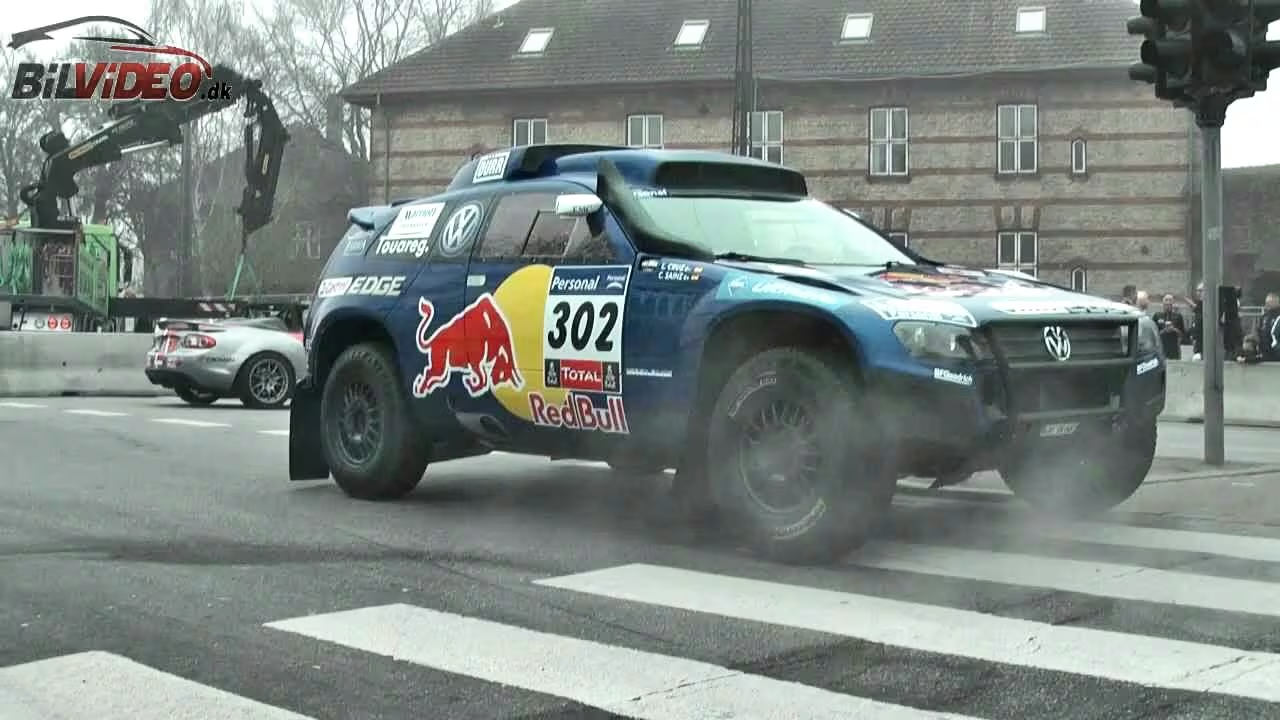
A ride in a VW Touareg Dakar? That's got to be fun!
And it was actually possible during Den Internationale Racing Festival 2012 at Carlsberg in Denmark. It's a charity event in aid of the Danish Red Cross, where you can buy a co-driver experience with a professional racing driver.
In this video you can see some highlights with a genuine Dakar Rally car, a VW Touareg Dakar 3.
VW Touareg Dakar: Master of the desert race
The Volkswagen Touareg is known as a luxury SUV that can handle most things on tarmac. But what many people might not know is that this car also has a remarkable history as an off-road champion, particularly in the notorious Dakar Rally. Since its debut in the demanding desert race, the Touareg has proven to be a force to be reckoned with, setting new standards for what an SUV can achieve in some of the world's most challenging terrain.
A brief introduction to the Dakar Rally
The Dakar Rally, formerly known as the Paris-Dakar Rally, is one of the most demanding off-road races in the world. It stretches over thousands of kilometres and covers some of the harshest landscapes, from the desert sands of the Sahara to the steep mountain passes of South America. The rally was first held in 1978 and has since become a test of both human endurance and technological innovation.
For manufacturers like Volkswagen, the Dakar Rally is an arena where the limits of a car's performance are pushed to the extreme. This is where the VW Touareg made its debut as an off-road giant and quickly established itself as a dominant force.
The VW Touareg's road to Dakar
The VW Touareg was originally developed as a luxury SUV for the mainstream market, but it quickly showed potential as a rugged off-road machine. Volkswagen decided to develop a special version of the Touareg specifically for the Dakar Rally. This initiative marked a decisive turning point in the brand's motorsport history and led to the development of the Volkswagen Race Touareg.
Race Touareg 1: The beginning
The first version of the Race Touareg made its debut at the Dakar Rally in 2003. It was a significant challenge to compete in a race known for destroying both cars and dreams. But VW's engineers had worked intensively to ensure their car could handle the desert's extreme conditions. The Race Touareg 1 was fitted with a 2.5 litre R5 TDI engine delivering 218 hp, enough to handle the toughest stretches of the rally.
Although the Race Touareg 1 didn't win on its debut, it showed potential by placing solidly among the best. It was clear VW had found a winning formula they would continue to refine.
Race Touareg 2: A new era
In 2006, Volkswagen introduced the Race Touareg 2, a significantly improved version of its predecessor. This version was fitted with a more powerful 2.5 litre R5 TDI engine, now producing 280 hp. The new engine was paired with a 5-speed sequential gearbox that allowed the power to be transferred efficiently to all four wheels, providing optimal traction on the challenging terrain.
The Race Touareg 2 was also fitted with an advanced suspension system that let the car handle the harshest bumps and holes in the desert sand. Independent long-travel suspension and a lightweight yet rigid chassis structure were key to the car's success.
This version became Volkswagen's first real success at Dakar, paving the way for even bigger victories. In 2009, Volkswagen managed to win the Dakar Rally for the first time with the Race Touareg 2, with Giniel de Villiers behind the wheel.
Race Touareg 3: The undisputed champion
The Volkswagen Race Touareg 3 was introduced in 2010, building on the successful elements of its predecessors. This version was fitted with an even more powerful 2.9 litre V6 TDI engine, delivering up to 310 hp. The improvements to the engine and suspension allowed the Race Touareg 3 to tackle even more challenging terrain and drive even faster through the desert's harsh landscapes.
With the Race Touareg 3, Volkswagen achieved two further victories at the Dakar Rally, in both 2010 and 2011. These wins cemented the VW Touareg's status as one of the most successful cars in Dakar's history. Under the leadership of Kris Nissen, who served as sporting director for Volkswagen Motorsport, the team achieved an almost flawless performance. Nissen's insight and experience were crucial to VW achieving these results.
The Race Touareg at a glance
| Year | Model | Engine | Result |
|---|---|---|---|
| 2003 | Race Touareg 1 | 2.5 litre R5 TDI, 218 hp | Dakar Rally debut, no win |
| 2006 | Race Touareg 2 | 2.5 litre R5 TDI, 280 hp | Introduced with a 5-speed sequential gearbox |
| 2009 | Race Touareg 2 | 2.5 litre R5 TDI, 280 hp | First Dakar win, Giniel de Villiers |
| 2010 | Race Touareg 3 | 2.9 litre V6 TDI, 310 hp | Introduced and won Dakar |
| 2011 | Race Touareg 3 | 2.9 litre V6 TDI, 310 hp | Dakar win, VW withdrew after the season |
The technology behind the successes
The success of the Volkswagen Race Touareg at the Dakar Rally can be attributed to a combination of advanced technology and meticulous engineering. The engines used in these cars were a further development of VW's TDI technology, tested and refined under the extreme conditions of Dakar. This included the use of turbo diesel engines that delivered not only high output but also excellent fuel economy, which was crucial in a long-distance race like Dakar.
The suspension system was another critical element of the car's success. With independent long-travel suspension, the Race Touareg could handle the toughest challenges in the desert, from rocky paths to soft sand. In addition, the car's aerodynamics were carefully designed to reduce drag, improving both speed and fuel efficiency.
Kris Nissen: The man behind the success
A key figure in Volkswagen's Dakar adventure was the Danish racing driver and team leader Kris Nissen. Nissen wasn't just responsible for coordinating the team, he also contributed his extensive experience from the world of motorsport to optimise the car's performance and strategies during the race. His leadership was crucial to the three consecutive wins at the Dakar Rally, and he was recognised as one of the key people behind VW's dominance in the race.
The VW Touareg Dakar's legacy
Although Volkswagen withdrew from the Dakar Rally after 2011 to focus on other motorsport projects, the legacy of the VW Touareg Dakar lives on. The experience and technologies developed during these races have found their way into later generations of Volkswagen's SUVs and have inspired other manufacturers to push the limits of what off-road vehicles can achieve.
The Race Touareg models haven't just left a lasting mark on motorsport, they've also cemented VW's reputation as a manufacturer capable of delivering high-performance vehicles even under the most extreme conditions. For off-road enthusiasts and motorsport fans, the VW Touareg Dakar is a legend that will be remembered for many years to come.
Comparison with competitors
Volkswagen's success with the Touareg at the Dakar Rally should also be seen in light of the competition. At the time, they were competing against brands like Mitsubishi and BMW, which also had strong traditions in rally racing. Nevertheless, VW managed to surpass these competitors through a combination of technological innovation and strategic leadership. While Mitsubishi had dominated in earlier years, it was VW that took the throne in the late 2000s, underlining the Touareg's superior capabilities in harsh terrain.
The Volkswagen Touareg's triumphs at the Dakar Rally are a story of technological innovation, strategic leadership and raw endurance. From its humble beginnings to becoming a three-time Dakar winner, the Touareg has proven itself one of the most impressive off-road vehicles in motorsport history. Kris Nissen's leadership and the VW team's dedication to perfection made the Touareg Dakar a car that didn't just win races, but also hearts around the world. This isn't just an SUV, it's a legend, born in the desert and forged by victories.